
Why Exit Interviews Matter More Than Ever
In today’s workforce, organizations across specialized industries are facing a growing nuclear talent shortage, a challenge that’s not just about hiring, but keeping the right people.
And here’s the uncomfortable truth:
Most companies are sitting on a goldmine of retention insights… and ignoring it.
Exit interviews are often treated as a formality, checkbox HR tasks that rarely lead to real change. But when done right, they become one of the most powerful tools to uncover why employees leave and how to stop the next one from walking out the door.
At The Atrium LLC, we’ve seen firsthand how structured exit interviews can turn departing employees into your most valuable consultants.
Let’s break down how to transform exit interviews into actionable retention strategies.
The Real Cost of the Nuclear Talent Shortage
The nuclear talent shortage isn’t just about empty roles, it’s about lost expertise, delayed projects, and increased risk.
When experienced professionals leave:
- Institutional knowledge walks out the door
- Remaining teams face burnout
- Recruitment costs skyrocket
- Compliance and safety risks increase
Now multiply that across an entire organization or industry.
That’s why every exit interview should answer one critical question:
“What could we have done to keep this person?”
Why Most Exit Interviews Fail
Let’s be honest, most exit interviews fail for predictable reasons:
❌ They’re too late
Employees are already checked out emotionally.
❌ They lack structure
Random questions = random insights.
❌ No follow-through
Feedback is collected… and forgotten.
❌ No data analysis
Patterns go unnoticed, so problems repeat.
If your current process isn’t producing clear retention fixes, it’s not working.
Designing an Effective Offboarding Feedback Survey
Before the conversation even begins, a strong offboarding feedback survey sets the foundation.
What to Include:
- Quantitative ratings (e.g., satisfaction with management, growth opportunities)
- Open-ended questions for deeper insights
- Consistency across all exits to identify trends
- Anonymity options for honest responses
Sample Survey Questions:
- On a scale of 1–10, how supported did you feel by your manager?
- What was the primary reason for your departure?
- What would have convinced you to stay?
- How would you describe team culture?
This survey primes the conversation and helps interviewers focus on the most important issues.
The Most Effective Exit Interview Questions
The quality of your insights depends entirely on your exit interview questions.
Here’s a proven mix that works:
1. The “Why” Question
- “What ultimately led you to decide to leave?”
2. The “Trigger” Question
- “Was there a specific moment or event that influenced your decision?”
3. The “Retention Lever” Question
- “What could we have changed to keep you here?”
4. The “Comparison” Question
- “What does your new role offer that we didn’t?”
5. The “Manager Feedback” Question
- “How would you describe your relationship with your manager?”
6. The “Culture Reality Check”
- “How would you describe the real culture here versus what was promised?”
Using an Employee Exit Interview Script for Consistency
A standardized employee exit interview script ensures every conversation produces usable data, not just anecdotes.
Why It Matters:
- Eliminates interviewer bias
- Ensures all critical topics are covered
- Makes responses easier to compare across employees
Sample Script Flow:
- Opening (Build Trust)
“This conversation is confidential and meant to improve the organization.” - Core Questions (Structured)
Use your predefined question set. - Deep Dive (Follow-Up)
Ask “why” multiple times to uncover root causes. - Closing Question
“What’s one thing we should fix immediately?”
Consistency is what turns feedback into patterns and patterns into solutions.
Identifying Turnover Root Cause Themes
This is where most companies drop the ball.
Collecting feedback is step one.
Analyzing it properly is where the magic happens.
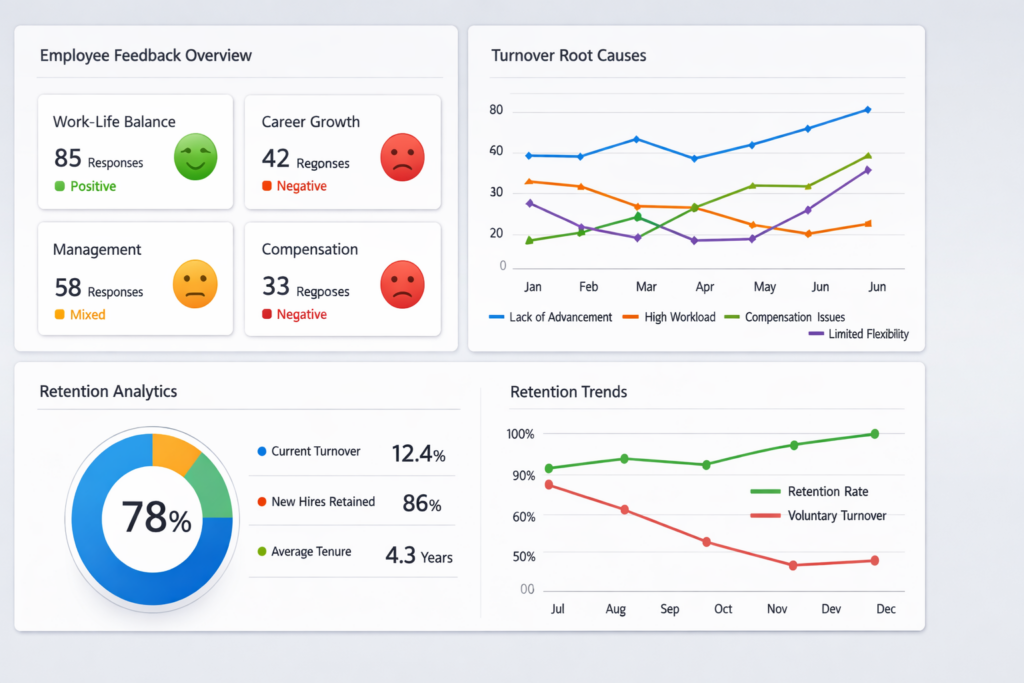
Common Turnover Root Cause Themes:
- Poor management or leadership gaps
- Lack of career growth
- Compensation misalignment
- Workload or burnout
- Cultural disconnect
- Ineffective communication
How to Spot Patterns:
- Group responses into categories
- Track frequency of each issue
- Compare across departments or roles
- Identify high-risk managers or teams
If 40% of exits mention lack of growth, that’s not feedback, that’s a systemic problem.
Data Review Steps That Drive Real Retention Fixes
To truly address the nuclear talent shortage, your data review process must be intentional and ongoing.
Step 1: Centralize the Data
Use a single system to collect all survey and interview responses.
Step 2: Categorize Feedback
Assign each response to a root cause theme.
Step 3: Quantify Trends
Turn qualitative feedback into measurable insights.
Step 4: Prioritize Issues
Focus on the highest-impact, most frequent problems.
Step 5: Assign Ownership
Every issue should have a leader responsible for fixing it.
Step 6: Track Improvements
Measure whether changes actually reduce turnover.
Real-World Scenario: Turning Exit Data Into Retention Wins
A mid-sized energy company was struggling with, you guessed it, the nuclear talent shortage.
They conducted exit interviews but weren’t seeing results.
After restructuring their process:
- Implemented a standardized offboarding feedback survey
- Introduced a consistent employee exit interview script
- Categorized feedback into turnover root cause themes
What They Discovered:
- 60% of employees cited lack of career progression
- 45% mentioned unclear expectations from managers
What They Did:
- Created clear career pathways
- Trained managers on goal-setting and communication
The Result:
- 28% reduction in turnover within 12 months
That’s the power of doing exit interviews right.
Frequently Asked Questions (FAQ)
What is the main goal of an exit interview?
To identify actionable insights that improve employee retention, not just to document why someone left.
How do you make exit interviews more honest?
- Ensure confidentiality
- Use neutral interviewers
- Include anonymous onboarding feedback surveys
How often should exit interview data be reviewed?
Monthly for trend tracking, with quarterly deep-dive analysis.
What’s the biggest mistake companies make?
Failing to act on the data. Insights without action = wasted opportunity.
Can exit interviews really solve retention issues?
Yes, when patterns are identified and addressed systematically, they become one of the most effective retention tools available.
Turning Insights Into Action
Exit interviews aren’t just about closure, they’re about course correction.
In an era defined by a nuclear talent shortage, organizations can’t afford to lose valuable employees without learning from it.
The companies that win are the ones that:
- Ask better questions
- Analyze data consistently
- Act on insights quickly
Because every exit is a warning signal, and an opportunity.
Ready to Turn Exit Interviews Into Retention Wins?
If your organization is struggling with retention or navigating the challenges of a nuclear talent shortage, it’s time to rethink your exit interview strategy.
The Atrium LLC specializes in transforming workforce data into actionable retention solutions.Schedule a Consultation today and start turning employee exits into your biggest competitive advantage.